

News for people with hearing and seeing problems
Some reports on encouraging recent developments for people with seeing and hearing difficulties…
— At the age of three months, USA-born David Paterson contracted an ear infection which spread to his optic nerve, leaving him with no sight in his left eye and severely limited vision in his right. In spite of his difficulties he obtained degrees in history and law. On 17 March 2008 Paterson was sworn in as governor of New York, the first legally blind and the first black governor there.
More signs of improvement
— In Denmark, 2000, the Danish Deaf Association started a project which led Professor Lars Williams to Uganda. His efforts required him to learn a Ugandan language and, with cooperation from others, resulted in the publication in 2007 of a sign language dictionary with more than 1,500 signs. Further information about this project and many others can be found at www.theinterpretersfriend.org.
— In the same year in Sri Lanka a dictionary of sign language was published. This can be downloaded free from www.rohanaspecialschool.org.
— There are now over 25 sign languages in Africa and the list is growing. On October 8, 1995, Uganda’s national sign language was recognised in the country’s new constitution, making Uganda Sign Language one of the few constitutionally recognised sign languages in the world. A Deaf signer (27-year-old Alex Ndeezi) was elected to the Ugandan parliament the following year.
— More recently a Medical Faculty in Charles University in Czech Republic introduced Basic, Intermediary (general) and Advanced (medical) optional courses for medical students. Each course, taught by a deaf lecturer, contributes to the final medical qualification. All the courses are oversubscribed.
— A sign language course has been set up by the Voluntary Service Overseas in collaboration with Kambara Deaf Association in a remote and rural part of Uganda, close to the border of Tanzania. It is for both deaf and hearing people and has attracted service providers from many walks of life. The aim was to allow deaf people in the town to be able to communicate with a shop keeper, taxi driver, civil servant, secretary of a CBO and a doctor etc. Hopefully the course will be extended for some who could progress to becoming sign language trainers.
— This year has also seen exciting links forming between schools for deaf children in Kenya and Uganda. A party of 21 people came to Uganda from Kenya which was treated to a programme of visits by Bbosa Billy, a teacher of deaf children. In May he organised a successful return trip to Kenya. The formation of this new link will hopefully lead to further exchanges of staff, students and ideas.
Bringing down the cost of better vision
Imagine a child with impaired sight being provided with a pair of glasses which are perfect for the needs, cheap, and require no specialised professional to help with the prescription. In two minutes the child can see enough to read or take a normal part in school…
That time is here! The World Health Organization estimates that world-wide about one billion people need corrective glasses but few have access to such care. Adaptive Eyecare Limited is a UK company formed to research, develop and apply adaptive ophthalmic lenses. The company was founded by Oxford physics professor Joshua Silver in 1996 and is based in the UK.
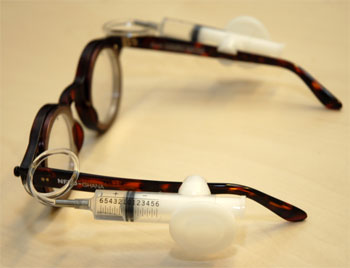
The company has developed prototype adaptive spectacles that can correct both far-sighted and near-sighted people, and these spectacles have been trialled in several countries in Africa and Asia. Look at the first photograph. Each lens is composed of two layers and the space in between is connected to a syringe which can inject a special gel to change the magnification.
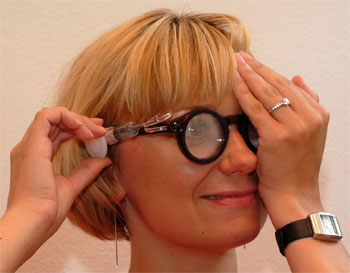
So you wear the glasses, close or screen one eye, and turn the small wheel on the other side until the vision in the open eye is corrected while focusing on print or a distant object. Then you change to the other eye. When both lenses are correctly adjusted, each screw at the front of the frames is tightened, the tubes cut and the syringes removed. Your optical prescription can even be read from the syringe graduations. Then you wear the glasses without the extra attachments. Now Professor Silver is in the process of creating a Vision Institute for the Developing World in Oxford. More information can be found at Centre for Vision in the Developing World.